
Memodyne Ingredients: What Is in Each Capsule and Why
Memodyne lists four active ingredients on the label: citicoline, bacopa monnieri, lion’s mane mushroom and vitamin B12. Every dose is printed, nothing is hidden in a proprietary blend, and the amounts match the published research more closely than most formulas in this category. The headline is the citicoline: 500 mg, the full daily dose used in the 12-week memory trial in older adults, where most competitors halve it to 250 mg. This breakdown explains what each ingredient does, how the printed dose compares to the studies, and what the label leaves out.
Written and fact-checked by RecallPath Editorial Team. Last updated: . About our editorial process.
- Citicoline 500 mg: the full studied memory dose. Nakazaki et al. (J Nutr, 2021) used 500 mg for 12 weeks in adults 50-85 with age-associated memory impairment; episodic memory improved.
- Bacopa monnieri 300 mg: standardized extract, matching the dose in Stough et al. (Psychopharmacology, 2001) that improved delayed word recall at 12 weeks.
- Lion’s mane 500 mg: fruiting body extract. Human data is early: a 16-week trial in mild cognitive impairment used 750 mg daily (Mori et al., 2009).
- Vitamin B12 500 mcg: corrects the deficiency that affects roughly 6 percent of adults over 60 and mimics memory loss. A corrector, not an enhancer.
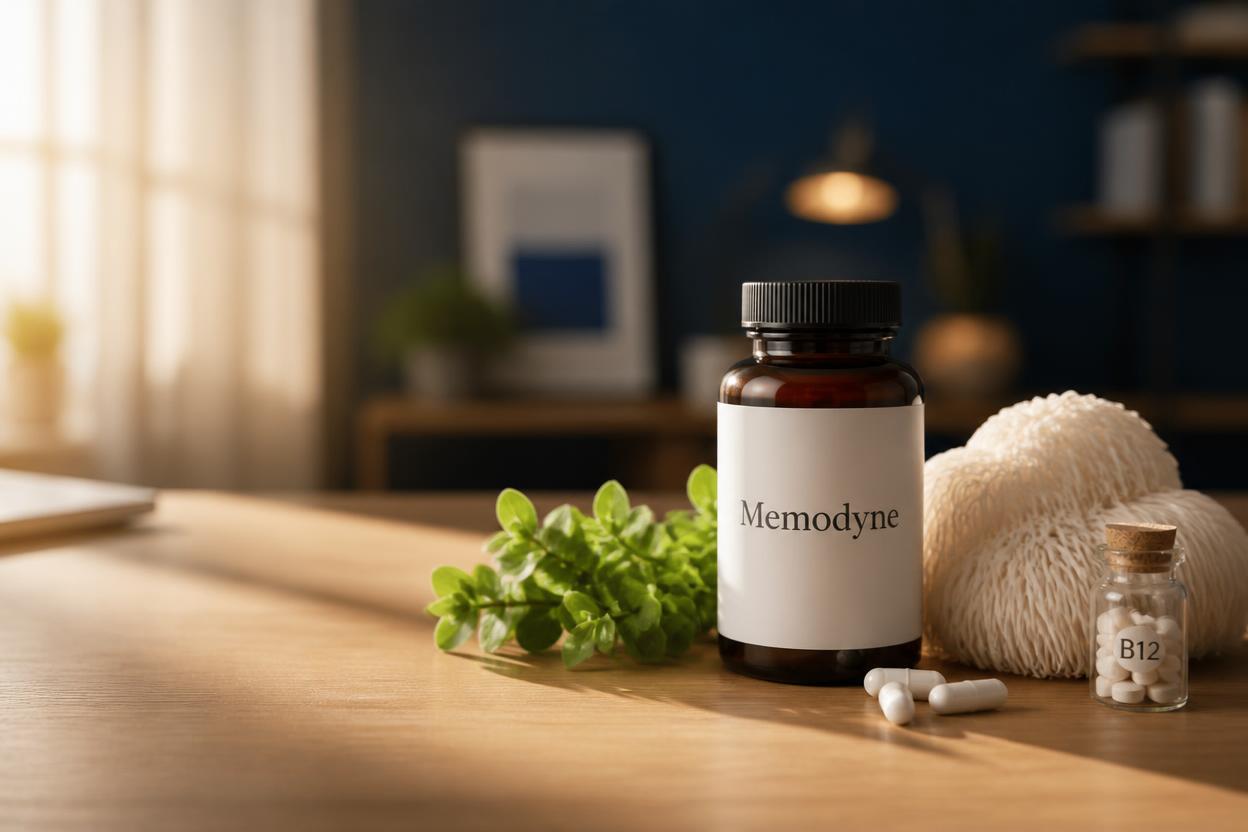
The four-ingredient formula
500 mg Citicoline (CDP-choline) Strongest evidence
Citicoline is a choline source that crosses into the brain efficiently, where it splits into choline for acetylcholine synthesis and cytidine for cell-membrane repair. Acetylcholine is the neurotransmitter most directly involved in encoding new memories.
The dose is the story. Nakazaki et al. (J Nutr, 2021, PMID 33978188) gave 500 mg of citicoline daily for 12 weeks to 100 adults aged 50-85 with age-associated memory impairment. Episodic memory improved on computerized testing (Paired Associate, p=0.0025; composite memory, p=0.0052). Most formulas on the market use 250 mg, exactly half, usually to fit the capsule count. Memodyne uses the full trial dose. The complete evidence picture is in our citicoline guide.
300 mg Bacopa monnieri (standardized) Strong herbal evidence
Bacopa is an Ayurvedic herb with the best human trial record of any herbal memory ingredient. Its active compounds, bacosides, support synaptic communication. The extract here is standardized for bacoside content, which keeps the active dose consistent from batch to batch.
The 300 mg dose matches Stough et al. (Psychopharmacology, 2001, PMID 11498727): 46 adults, 12 weeks, improved delayed word recall. Bacopa is slow and honest: nothing meaningful before 8 to 12 weeks. Anyone selling faster results is selling something else.
500 mg Lion’s mane (Hericium erinaceus) Early-stage
A medicinal mushroom studied for stimulating nerve growth factor. The human data is promising but preliminary: Mori et al. (2009) gave 750 mg daily for 16 weeks to 30 adults with mild cognitive impairment and saw improved cognitive scores, which declined again after a 4-week washout. Memodyne’s 500 mg sits below that trial dose and within the range of more recent studies. It is the formula’s structural bet, not its proven core. Full check in our lion’s mane guide.
500 mcg Vitamin B12 (methylcobalamin) Deficiency corrector
B12 is a cofactor for the enzymes that clear homocysteine and methylmalonic acid. When it runs low, both accumulate and neurological symptoms follow: memory slips, fatigue, tingling. Roughly 6 percent of adults over 60 are clinically deficient, and low B12 is a recognized mimic of memory loss. The 500 mcg dose covers the gap. What it does not do is enhance cognition in people with normal levels, which is why the B12 guide starts with a blood test, not a bottle.
How the four work together
Citicoline supplies the raw material for the memory neurotransmitter. Bacopa shapes how memory circuits use it. Lion’s mane targets nerve growth, the structural layer. B12 keeps the deficiency mimic out of the picture. The stack reads like a plan rather than a pile: one modern RCT at full dose, one classic herbal trial, one early-stage structural play, one nutritional safety net.
The one honest weakness: lion’s mane is the least proven ingredient here, at a dose below its main trial. The formula would still stand on citicoline and bacopa alone, which is more than most four-ingredient blends can say.
What is not in the bottle
- Caffeine or stimulants. No guarana, no synephrine. The formula does not borrow energy from tomorrow.
- Proprietary blend. Every milligram is printed on the Supplement Facts panel. You can verify each dose against the research yourself.
- Phosphatidylserine or ginkgo. Common memory-formula ingredients, absent here. PS has modest data; ginkgo carries a bleeding-interaction profile. Their absence narrows the interaction surface.
- Artificial dyes. The capsules are plain, with standard excipients for stability.
Who each ingredient helps most
| Ingredient | Best for | Time to judge |
|---|---|---|
Citicoline 500 mg |
Episodic memory and mental energy in adults 50-85 with mild age-related concerns |
8-12 weeks |
Bacopa 300 mg |
Delayed recall and word learning; patients willing to wait 3 months |
12 weeks |
Lion’s mane 500 mg |
Structural nerve support; early data, reasonable as a long-term bet |
16 weeks, honestly unproven |
B12 500 mcg |
Deficiency correction, especially after 60, with metformin or PPI use |
Weeks if deficient; nothing if replete |
The bottom line
Memodyne’s label is what supplement labels should look like: four ingredients, four printed doses, and a core pair that matches the research at full strength. The citicoline dose alone separates it from most of the category. The formula’s ceiling remains the category’s ceiling: bacopa needs 12 weeks, lion’s mane needs more human data, and no capsule treats dementia. But as a transparent, stimulant-free memory formula, the label earns its keep. For the full safety picture, read our Memodyne side effects guide.
Frequently Asked Questions
What are the ingredients in Memodyne?
Four active ingredients, all with printed doses: citicoline 500 mg, bacopa monnieri extract 300 mg (standardized for bacosides), lion’s mane fruiting body extract 500 mg, and vitamin B12 500 mcg. No proprietary blend, no caffeine, no stimulants.
Why is the citicoline dose important?
Because the main human memory trial used 500 mg. Nakazaki et al. (2021) dosed 500 mg daily for 12 weeks in adults with age-associated memory impairment and measured improved episodic memory. Many competing formulas list citicoline at 250 mg, half the studied amount, while citing the same trial. Matching dose to evidence is the whole point of reading a label.
Is the bacopa in Memodyne standardized?
Yes. The label specifies a bacoside-standardized extract. Standardization guarantees a consistent percentage of active compounds per batch. Plain bacopa leaf powder varies widely in potency and is not equivalent to the extracts used in the trials.
Is lion’s mane a proven memory ingredient?
Not yet. The human evidence is early: one 16-week trial of 30 adults with mild cognitive impairment showed improved scores on 750 mg daily, with scores declining after a washout. Memodyne contains 500 mg. It is a reasonable structural bet with unproven results, and this guide says so plainly.
Do I need B12 if my memory is fine?
You need adequate B12, but supplementation only helps if you are low. Roughly 6 percent of adults over 60 are deficient, and low B12 mimics memory loss. Trials in replete adults show no cognitive benefit from extra B12. A blood test answers the question in one visit and costs less than a bottle.
Does Memodyne contain caffeine?
No. The formula is stimulant-free. Citicoline provides mild mental activation through cholinergic support, not through stimulants, so there is no crash cycle and no sleep interference when taken in the morning.
How do the Memodyne ingredients interact with each other?
No harmful interactions are documented between the four. Citicoline and bacopa are commonly paired in formulas and target different angles of memory processing. The main interaction concerns are external, with medications: bacopa affects liver enzymes that metabolize certain antidepressants, and citicoline can amplify levodopa and other cholinergic drugs. Those belong in a conversation with your doctor.
Sources and References
- Nakazaki et al. – Citicoline and memory in AAMI – J Nutr, 2021 (PMID 33978188)
- Stough et al. – Bacopa and delayed recall – Psychopharmacology, 2001 (PMID 11498727)
- Mori et al. – Lion’s mane in mild cognitive impairment – 2009
- Vitamin B12 – NIH Office of Dietary Supplements
- Bacopa Monnieri – Examine.com
Need help choosing?
RecallPath does not sell supplements. We publish facts for readers over 40.
Email us