
Memodyne Review: Label, Doses and Who Should Skip It
Memodyne is a four-ingredient memory formula that prints every dose on the label: citicoline, bacopa monnieri, lion’s mane mushroom and vitamin B12. No proprietary blend, no caffeine, no miracle language. The headline detail is the citicoline dose: 500 mg, the full amount used in the 12-week memory trial in older adults with age-associated memory concerns, not the halved 250 mg found in many formulas. This review breaks down each line of the label, who the formula fits, and who should skip it first.
Written and fact-checked by RecallPath Editorial Team. Last updated: . About our editorial process.
- Citicoline: 500 mg. The full studied memory dose. Nakazaki et al. (J Nutr, 2021) used 500 mg over 12 weeks in adults 50-85 with age-associated memory impairment and found improved episodic memory.
- Bacopa monnieri: 300 mg, standardized for bacosides. Matches the dose from Stough et al. (Psychopharmacology, 2001): improved delayed word recall at 12 weeks.
- Lion’s mane: 500 mg fruiting body extract. Human data is early but promising: a 16-week trial in mild cognitive impairment (n=30) used 750 mg daily (Mori et al., 2009).
- Vitamin B12: 500 mcg. Covers the deficiency common after 60. A corrector, not an enhancer.
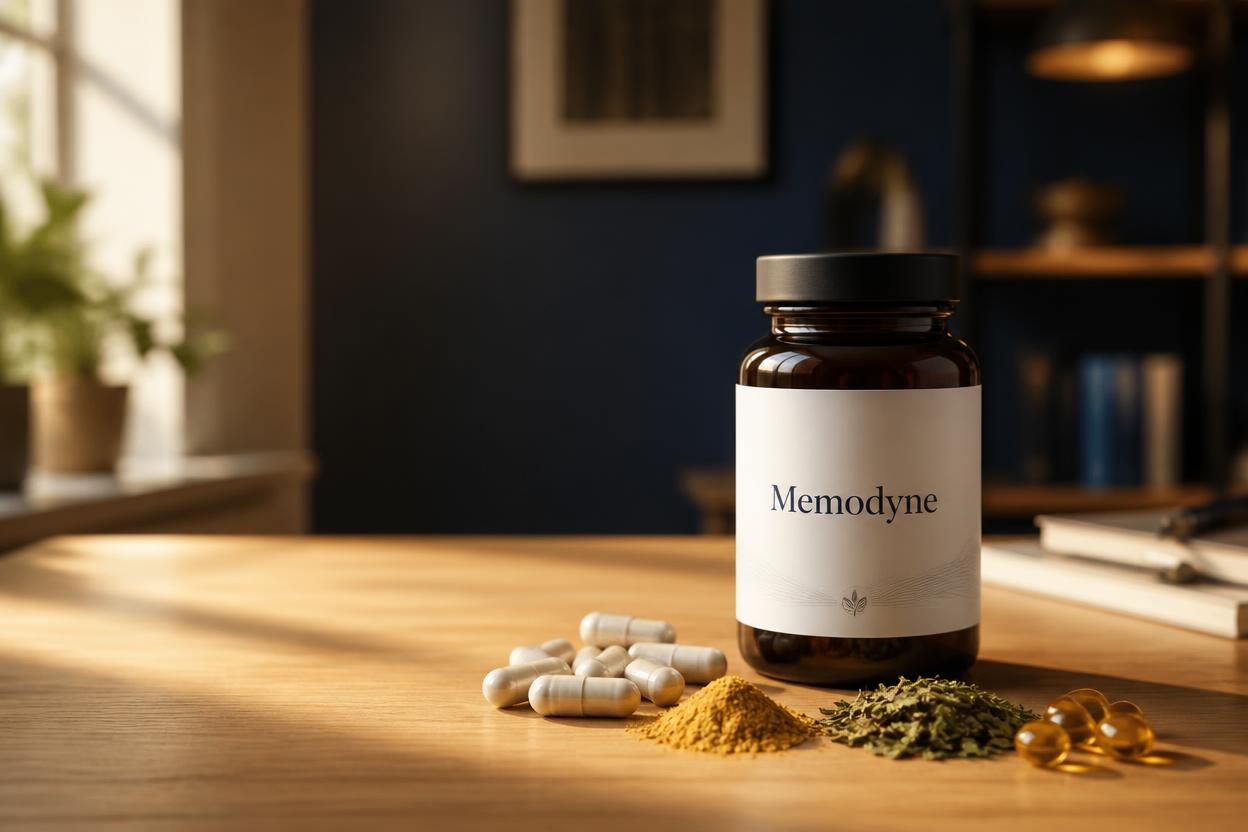
Memodyne passes the two tests that matter: the citicoline dose matches the full studied amount, and every milligram is printed. The honest caveats are the same as for the category itself: bacopa needs 8-12 weeks, lion’s mane human data is early-stage, and B12 only helps if you run low.
If you want a stimulant-free memory formula with the citicoline dose from the actual trial, Memodyne qualifies. If you are allergic to mushrooms, take anticholinergic medication, or want results this week, see the notes below first.
The label, line by line
Every amount printed per daily serving. Bacopa is standardized for bacosides, which keeps the active content consistent batch to batch.
What each ingredient does at this dose
500 mg Citicoline
The anchor of the formula. Nakazaki et al. (J Nutr, 2021, PMID 33978188) gave 500 mg of Cognizin citicoline daily for 12 weeks to 100 adults aged 50-85 with age-associated memory impairment. Episodic memory improved on computerized testing (Paired Associate, p=0.0025; composite memory, p=0.0052). This is the trial most memory formulas cite, and most of them halve the dose to 250 mg to save capsule space. Memodyne does not. Full breakdown in our citicoline guide.
300 mg Bacopa monnieri
The best-evidenced herbal memory ingredient. Stough et al. (Psychopharmacology, 2001, PMID 11498727) used 300 mg of a bacoside-standardized extract for 12 weeks in 46 adults and found improved delayed word recall. Bacopa works on a slow clock: 8-12 weeks minimum before judging. Anything felt in days is placebo or caffeine, and this formula contains neither.
500 mg Lion’s mane
A medicinal mushroom studied for nerve-growth stimulation. The human data is early: Mori et al. (2009) gave 750 mg daily for 16 weeks to 30 adults with mild cognitive impairment and saw improved cognitive scores, with scores declining again after a 4-week washout. Memodyne’s 500 mg is below that trial dose but within the range used in more recent studies. Treat it as the promising, unproven line of the formula. Full evidence check in our lion’s mane guide.
500 mcg Vitamin B12
A deficiency corrector. Roughly 6 percent of adults over 60 are B12 deficient and low B12 mimics memory loss. Trials in people with normal B12 show no cognitive benefit from supplementing, which is why B12 belongs in a formula aimed at the 50-plus crowd, and why the B12 guide recommends a blood test before expecting anything from it.
How the four hang together
Citicoline supplies choline for acetylcholine synthesis, the neurotransmitter involved in memory encoding. Bacopa modulates how memory circuits use that signal. Lion’s mane targets nerve growth, a structural angle. B12 corrects the deficiency that quietly mimics dementia after 60. It is a coherent stack: one ingredient with a strong modern RCT at full dose, one classic herbal with 12-week data, one early-stage structural play, one deficiency net.
The formula is designed for the person with mild, gradual memory concerns who wants the studied citicoline dose without stimulants. It is not a treatment for dementia, and the label does not claim otherwise.
Who Memodyne fits, and who should skip it
Good fit
Adults 50-80 with mild, gradual memory concerns who will judge it at 8-12 weeks. People who want the full 500 mg citicoline dose. Anyone avoiding caffeine and proprietary blends. People whose B12 status is unknown and worth testing anyway.
Skip it
Mushroom allergy: lion’s mane can trigger reactions in mushroom-sensitive people. Anticholinergic medication users: citicoline can oppose those drugs; talk to your doctor. Anyone expecting results in days. Anyone with sudden or severe memory loss: that needs a doctor, not a bottle.
The complaints, honestly
- Results are invisible at week one. Citicoline builds steadily; bacopa needs its 12 weeks. The honest window is two to three months.
- Some users report vivid dreams or mild insomnia in the first weeks on citicoline. Take the dose in the morning; it usually settles.
- Four capsules a day at full dose. Manageable, but worth knowing before you commit.
None of these change the verdict. All of them are worth knowing before you decide.
The bottom line
Memodyne does the two things most memory formulas skip: it uses the full 500 mg citicoline dose from the Nakazaki trial, and it prints every milligram. Bacopa adds the strongest herbal memory data at its studied dose, lion’s mane adds an early-stage structural angle, and B12 covers a real deficiency risk after 60. If that profile matches you, and you can give it an honest 12 weeks, it is a defensible choice in a category full of proprietary blends and halved doses. The full safety picture lives in our ingredient guides, linked below.
Frequently Asked Questions
How long does Memodyne take to work?
Eight to twelve weeks. The citicoline memory trial ran 12 weeks, and bacopa’s delayed-recall effect was measured at 12 weeks. Early changes, where they appear, are subtle. Judge at week twelve with a written note of where you started, not at week two by feel.
Does Memodyne contain caffeine?
No. The formula is stimulant-free: citicoline, bacopa, lion’s mane and B12. Any mental energy effect comes from cholinergic support, not stimulants, which means no afternoon crash and no sleep disruption when taken in the morning.
How is Memodyne different from Harmo Brain?
The citicoline dose: 500 mg in Memodyne versus 250 mg in Harmo Brain. Memodyne also swaps phosphatidylserine for lion’s mane and adds B12. If your priority is the memory trial dose of citicoline, Memodyne matches it. If you want phosphatidylserine in the mix, Harmo Brain covers that.
Can citicoline cause insomnia or headaches?
It can. Citicoline is a cholinergic, and some users report headache, vivid dreams or difficulty sleeping, especially with evening doses. Take it in the morning. If headaches persist beyond the first two weeks, stop and talk to your doctor.
Is lion’s mane safe if I have a mushroom allergy?
No. People with mushroom allergies have reported skin reactions and breathing difficulty from lion’s mane supplements. With a known mushroom allergy, skip Memodyne entirely and look at citicoline-plus-bacopa formulas without the fungal ingredient.
Is Memodyne safe for seniors?
For most healthy adults over 50, yes: the doses sit within studied ranges and the formula is stimulant-free. The exceptions that matter: mushroom allergy, anticholinergic medications such as some bladder and allergy drugs, and any memory problem that appeared suddenly. Those belong in a doctor’s office, not a supplement routine.
Can I take Memodyne with my medication?
Ask your doctor and bring the label. The key interaction class is anticholinergic medication, which citicoline can oppose. For most other prescriptions there is no documented interaction, but a four-ingredient label makes the doctor conversation short either way.
Will Memodyne help with dementia?
No supplement treats dementia, and Memodyne does not claim to. The citicoline trial studied age-associated memory impairment, a milder category. If memory loss is sudden, severe or affecting daily life, that is a medical evaluation, whatever the bottle says.
Sources and References
Need help choosing?
RecallPath does not sell supplements. We publish facts for readers over 40.
Email us- Citicoline Guide – the Nakazaki trial decoded: dose, cohort, what improved and what did not
- Bacopa Monnieri Guide – why 12 weeks is non-negotiable and what bacoside standardization means
- Lion’s Mane Guide – the human trial data, the allergy risk and the evidence ceiling
- Vitamin B12 Guide – who is actually deficient and why replete users feel nothing