
Memodyne vs Prevagen: What the Trials Actually Show
Prevagen and Memodyne are both marketed for memory after 40, but their evidence bases could not look more different. Prevagen’s sole published trial, the Madison Memory Study, found no statistically significant improvement on any of nine cognitive tasks in the full study population; the claimed benefits came from post-hoc subgroup analyses (Merck Manuals). In December 2024, a federal court ordered Prevagen’s maker to stop making its core memory claims nationwide. Memodyne’s core ingredient, citicoline, carries a 12-week randomized trial in 100 adults with age-associated memory impairment, published in the Journal of Nutrition (PMID 33978188). This comparison sticks to trial data, court records and what each label actually discloses.
Written and fact-checked by RecallPath Editorial Team. Last updated: . About our editorial process.
- Prevagen’s active ingredient: apoaequorin, a synthetic jellyfish-derived protein, 10 mg in Regular and 20 mg in Extra Strength. Merck Manuals: no high-quality studies demonstrate it improves memory.
- Prevagen’s own trial: 218 adults, 90 days, no significant result on any of nine cognitive tasks in the full population. Significance appeared only in after-the-fact subgroup analyses.
- The court record: FTC and the New York Attorney General charged false advertising in 2017; a 2024 jury found the establishment claims lacked reliable scientific evidence; a December 2024 injunction bars all eight challenged claims nationwide; a consumer class settlement covering up to 3 million buyers was before a Florida court in 2026.
- Memodyne’s core: citicoline 500 mg, the full dose from the Nakazaki 2021 trial (improved episodic memory, p=0.0025), plus bacopa 300 mg at its studied dose.
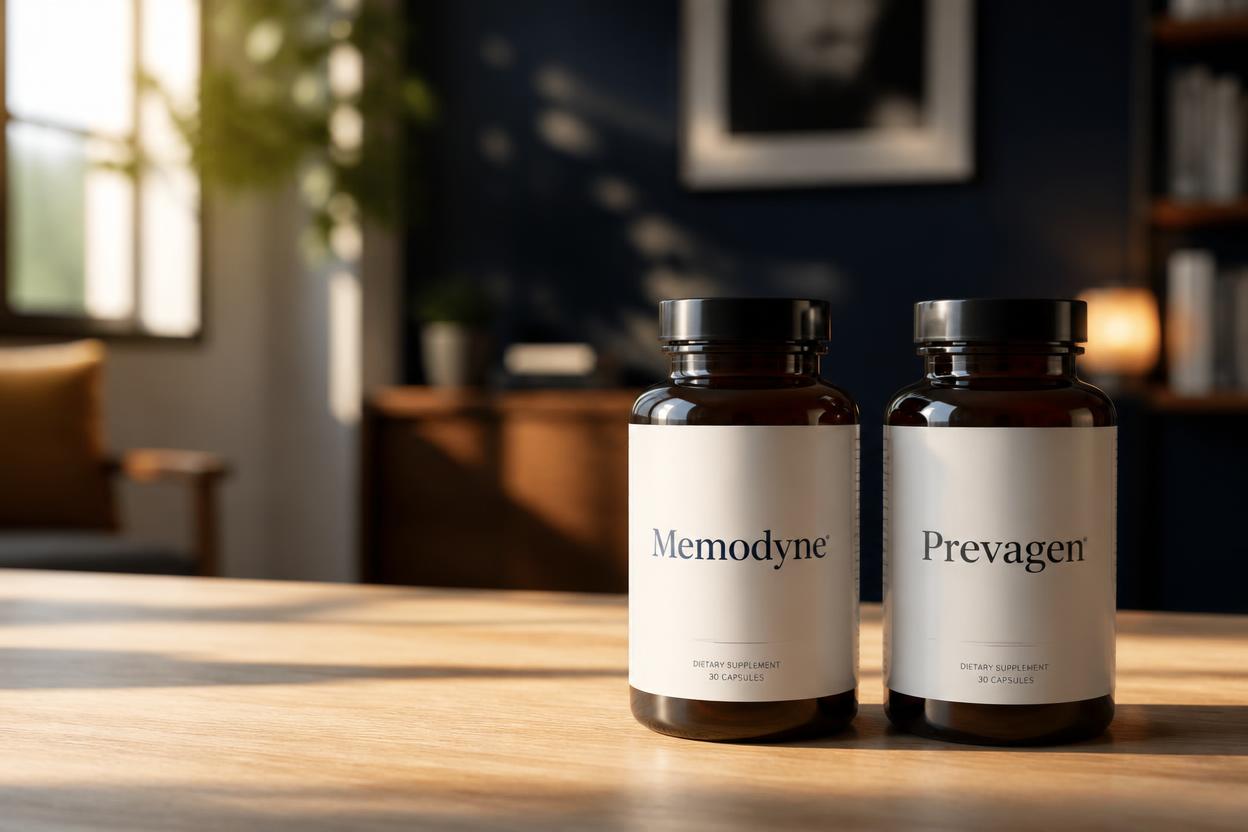
What each bottle contains
| Prevagen Regular / Extra Strength | Memodyne | |
|---|---|---|
Active ingredient(s) |
Apoaequorin 10 mg / 20 mg (a synthetic protein originally derived from jellyfish) |
Citicoline 500 mg, bacopa monnieri 300 mg, lion’s mane 500 mg, vitamin B12 500 mcg |
Evidence basis |
One company trial, 218 participants, 90 days; no significant full-population result |
Citicoline: 12-week RCT, n=100, positive primary endpoint; bacopa: 12-week RCT, n=46, positive |
Key study detail |
Benefits claimed from post-hoc subgroup analyses of the failed primary analysis |
Nakazaki 2021, J Nutr: episodic memory p=0.0025 in AAMI adults 50-85 (PMID 33978188) |
Regulatory history |
FTC/NYAG charges 2017; nationwide injunction on memory claims, December 2024 |
No regulatory actions on record |
The Prevagen trial, honestly
Prevagen’s marketing long cited a single clinical trial: the Madison Memory Study, a 90-day test of 218 adults aged 40-91 with self-reported memory concerns, randomized to 10 mg of apoaequorin or placebo. The result, published in 2015 (PubMed 26878676): no statistically significant improvement on any of the nine computerized cognitive tasks in the study population as a whole. The claims of benefit rested on subgroup analyses conducted after the data was collected, slicing the population until a slice showed significance. Post-hoc subgroup findings are hypothesis-generating at best, and the trial itself stated that confirmatory studies were needed.
Merck Manuals’ consumer reference now states it plainly: there are no high-quality studies demonstrating that apoaequorin improves memory loss, and its safety profile is not well characterized. Reported adverse effects include headache, dizziness, nausea, memory problems, difficulty sleeping and anxiety.
What happened in court
-
January 2017
The Federal Trade Commission and the New York Attorney General charge Quincy Bioscience with false and unsubstantiated advertising over claims that Prevagen is “clinically shown” to improve memory within 90 days.
-
February 2024
A federal jury in New York returns a split verdict: it finds Prevagen’s establishment claims lacked competent and reliable scientific evidence, and that the statement it “reduces memory problems associated with aging” was materially misleading.
-
December 2024
The court issues a nationwide injunction ordering Quincy to cease all eight challenged marketing claims. The company has appealed; the case was before the Second Circuit in late 2025.
-
2025-2026
A nationwide consumer class settlement covering purchases from 2014 onward, with partial refunds to an estimated 3 million consumers and mandatory label changes, was before a federal court in Florida for approval in 2026.
None of this says Prevagen harms people. It says the marketing outran the evidence, and two court proceedings have now put that gap on the record. The product remains sold, now with revised labeling.
The Memodyne side of the comparison
Memodyne’s anchor ingredient, citicoline, was tested in a 12-week randomized, double-blind, placebo-controlled trial: 100 adults aged 50-85 with age-associated memory impairment, 500 mg daily, computerized cognitive testing. Episodic memory improved (Paired Associate learning, p=0.0025; composite memory, p=0.0052). Bacopa adds a second positive RCT at the formula’s exact dose: 300 mg for 12 weeks improved delayed word recall in 46 adults (Stough et al., 2001).
The honest caveats, because a comparison that hides them is just marketing in the opposite direction: the Memodyne trial was company-funded, as most supplement trials are, including Prevagen’s and Neuriva’s. Lion’s mane in the formula has early-stage data only. And no ingredient in either bottle treats dementia. The difference is not good versus evil. It is a published positive primary endpoint versus a failed one.
Where Neuriva fits in
Neuriva, the other heavily advertised memory brand, contains coffee cherry extract (100 mg) and phosphatidylserine (100 mg). Its evidence is a single 42-day randomized trial of 138 healthy adults with self-perceived memory problems, published in 2023: improved performance on computerized cognitive tasks versus placebo, with the manufacturer involved in the research (PMC10195946). The phosphatidylserine dose sits at the low end of the studied range. It is one small, short, positive trial. That puts Neuriva a tier above Prevagen and a tier below formulas matching the citicoline and bacopa trial doses.
If you are choosing between them
By trial data: a formula built on 500 mg citicoline plus 300 mg standardized bacopa has the strongest published human evidence in this comparison, and Memodyne’s label prints both doses in full. By price and availability, Prevagen and Neuriva sit on mainstream retail shelves, which some buyers value more than trial readouts. Neither category treats dementia. If memory problems are sudden, severe or progressive, the right next step is a doctor either way.
The full breakdown of Memodyne’s label is in our Memodyne review, and the category landscape is in the best memory supplements guide.
Frequently Asked Questions
Is Prevagen proven to improve memory?
Its maker’s own 218-person trial found no statistically significant improvement on any of nine cognitive tasks in the full study population. Claims of benefit relied on post-hoc subgroup analyses. Merck Manuals states there are no high-quality studies demonstrating apoaequorin improves memory loss.
What is apoaequorin?
A protein originally identified in jellyfish, produced synthetically for supplements. Prevagen contains 10 mg per capsule in Regular and 20 mg in Extra Strength. It has no published mechanism demonstrated to affect human memory, and its long-term safety in humans is not well characterized.
What happened with the Prevagen lawsuits?
The FTC and New York Attorney General charged false advertising in 2017. A 2024 jury found the establishment claims lacked reliable scientific evidence, and a December 2024 injunction ordered the company to stop all eight challenged claims nationwide. A separate consumer class settlement covering partial refunds was pending court approval in 2026. The company has appealed.
Is Prevagen still sold?
Yes. It remains widely available in U.S. retail with revised labeling. The court orders restrict what the company may claim in advertising, not what consumers may buy. Whether it is worth buying is a question the trial data above answers for itself.
Which is better, Memodyne or Prevagen?
By published trial data, Memodyne: its core ingredients match randomized trials with positive primary endpoints at the labeled doses, while Prevagen’s own trial found no full-population effect. Neither treats dementia, and neither works in days. If retail availability matters more to you than trial readouts, that is a legitimate preference.
How does Neuriva compare to Prevagen?
Neuriva has a real, published randomized trial behind it, a 42-day study of 138 adults showing improved computerized cognitive scores, though the manufacturer was involved in the research and the phosphatidylserine dose is at the low end of the studied range. Prevagen’s trial showed no significant full-population effect. By evidence, Neuriva ranks above Prevagen.
Does Prevagen have side effects?
Reported adverse effects include headache, dizziness, nausea, difficulty sleeping, anxiety and, ironically, memory problems. Because apoaequorin is a novel synthetic protein with limited long-term human safety data, unexpected effects are harder to rule out than with ingredients studied for decades.
Sources and References
- FTC press release – Prevagen charges, January 2017
- Madison Memory Study – apoaequorin 10 mg, 90 days, n=218 (PubMed 26878676)
- Apoaequorin – Merck Manuals, Consumer Version
- Neuriva RCT – coffee cherry extract + phosphatidylserine, n=138, 42 days – PMC10195946
- Nakazaki et al. – Citicoline and memory in AAMI – J Nutr, 2021 (PMID 33978188)
- Stough et al. – Bacopa and delayed recall – Psychopharmacology, 2001 (PMID 11498727)
Need help choosing?
RecallPath does not sell supplements. We publish facts for readers over 40.
Email us