
VapoCept Ingredients: What Is in Each Serving and Why
VapoCept lists seven active ingredients on the label, and every dose is printed: citrulline 1,500 mg, arginine 1,000 mg, beetroot extract 500 mg, niacin 16 mg, pine bark extract 100 mg, theanine 200 mg and vitamin C 90 mg. There is no proprietary blend and nothing to decode. The design logic is a two-route nitric-oxide strategy: citrulline feeds arginine through the kidneys while beetroot nitrate feeds NO through the oral bacteria pathway, and theanine sits on top as the formula’s only classic cognitive ingredient. This breakdown checks each dose against the published research, names what the label leaves out, and says plainly where the evidence is strong and where it is early.
Written and fact-checked by RecallPath Editorial Team. Last updated: . About our editorial process.
- L-citrulline 1,500 mg: raises blood arginine as effectively as 3.2 g of arginine, with less GI distress (PMC6073798). The anchor of the formula.
- L-arginine 1,000 mg: the direct NO precursor; supports the pathway while citrulline does the heavy lifting.
- Beetroot extract 500 mg: dietary nitrate studied at 200-800 mg for blood-pressure effects; the second NO route.
- Theanine 200 mg: the only classic cognitive ingredient, at its studied attention dose.
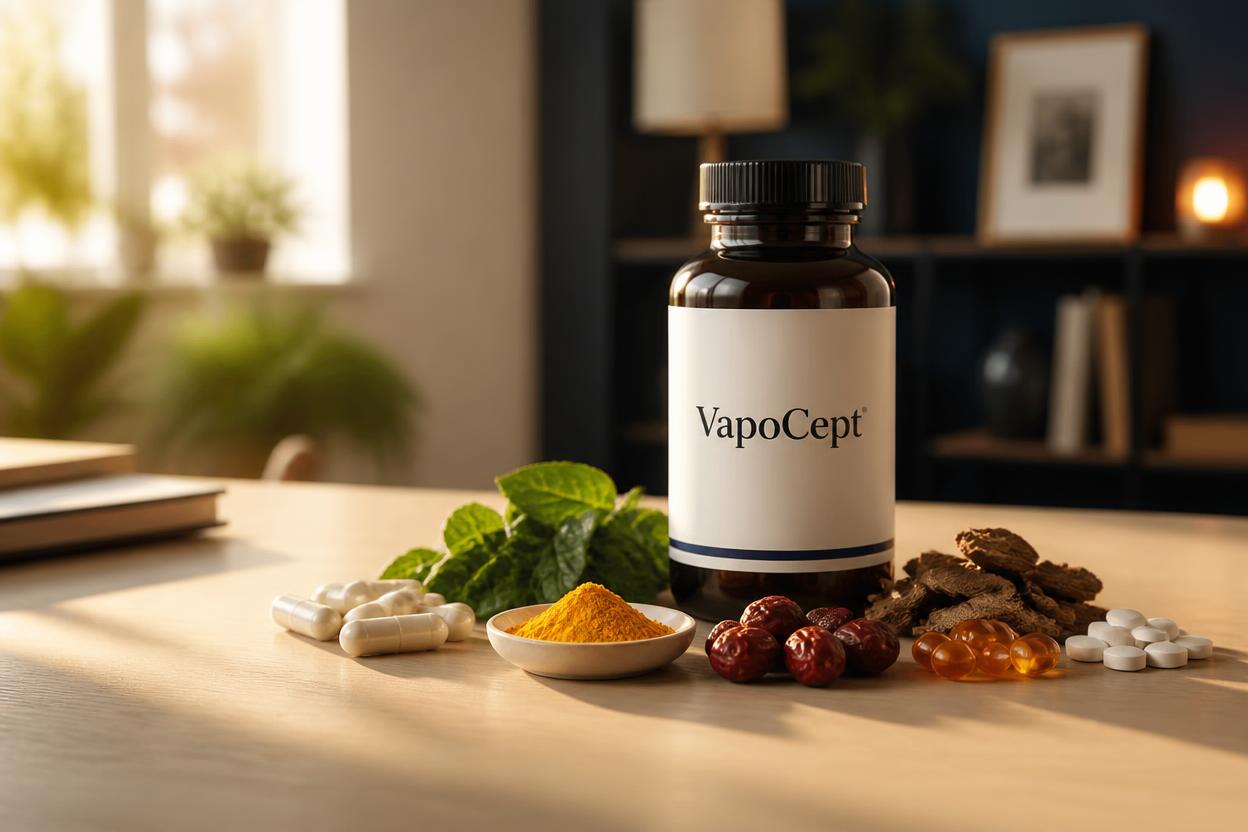
The seven-ingredient formula
Seven doses vs the research
| Ingredient | In VapoCept | Studied range | Match |
|---|---|---|---|
L-citrulline |
1,500 mg |
1.5 g shown to match 3.2 g arginine for blood arginine; tolerated to 15 g |
On target |
L-arginine |
1,000 mg |
Vascular studies typically use 1.5-6 g; 1 g is a supporting dose |
Below typical range |
Beetroot nitrate |
500 mg extract |
Blood-pressure trials use 200-800 mg nitrate |
In range |
Niacin |
16 mg |
Adult daily value; flush typically at higher doses |
RDA level |
Pine bark |
100 mg |
Endothelial trials use 100-200 mg |
Low end |
L-theanine |
200 mg |
Attention studies use 100-400 mg; 200 mg is the classic dose |
Studied dose |
Vitamin C |
90 mg |
RDA; supports NO stability |
RDA level |
Four of seven doses sit exactly where the research sits; two are deliberately conservative (arginine, pine bark); one is RDA-level support. That is a better match rate than most formulas in this category, and the two conservative choices are defensible: arginine’s higher doses bring the GI side effects citrulline avoids, and pine bark’s stronger trials are still preliminary.
What each ingredient does and why it is there
1,500 mg L-citrulline Anchor ingredient
Converted to arginine in the kidneys, which then feeds nitric-oxide production. The pharmacokinetics are the reason it leads the formula: 1.5 g of citrulline raises plasma arginine as effectively as 3.2 g of oral arginine, bypasses first-pass breakdown in the gut, and is tolerated up to ten times this dose (PMC6073798). It is the most evidence-matched ingredient in the bottle.
1,000 mg L-arginine Supporting route
The direct substrate for NO synthase. Oral arginine loses a meaningful fraction to intestinal breakdown before it reaches circulation, which is why it plays second fiddle to citrulline here. Its role is to keep the direct pathway supplied while citrulline sustains the levels. For the safety profile of this line, including the blood-pressure interaction, see our side effects guide.
500 mg Beetroot extract Second NO route
Where citrulline works through the arginine pathway, beetroot nitrate works through bacteria on the tongue, which reduce nitrate to nitrite and then to NO in blood and tissue. A 2025 meta-analysis found 200 to 800 mg of nitrate lowers systolic pressure by roughly 5 mmHg in hypertensive adults, strongest in those with elevated pressure. Two independent routes to the same molecule is smart formulation, not redundancy.
16 mg Niacin, nicotinic acid RDA-level
The adult daily value, in the form that supports cellular energy metabolism. Nicotinic acid also dilates small skin vessels at higher doses, which is the harmless first-week flush some users notice. At 16 mg the flush is uncommon; the form choice is intentional, not filler.
100 mg Pine bark extract Low end of range
Procyanidin antioxidants with small trials on endothelial function at 100 to 200 mg. The evidence is encouraging but preliminary, and VapoCept’s dose sits at the bottom of the studied range. An honest supporting player, dosed conservatively.
200 mg L-theanine Studied dose
The formula’s only classic cognitive ingredient, at the dose attention research actually uses. Theanine promotes alpha-wave activity and calm focus without stimulation. Because VapoCept contains no caffeine, theanine’s role here is smoothing: it takes the edge off the vascular drive rather than adding stimulation. The caffeine pairing, for comparison, is covered in our caffeine vs nootropics guide and the theanine guide.
90 mg Vitamin C Supporting role
Limits the oxidation of nitric oxide in the bloodstream, helping the molecule the other six ingredients are built around survive longer. At the daily value, it is cheap insurance rather than a driver.
How the seven hang together
The design is a two-engine NO strategy with a calming layer. Citrulline and arginine feed the arginine pathway; beetroot feeds the nitrate pathway; vitamin C protects the product of both; niacin supports the energy metabolism that runs the whole system; pine bark adds endothelial antioxidant support; theanine keeps the feel calm rather than wired. Every line has a job, nothing is at a dust dose, and nothing is hidden.
The formula’s ceiling is also honest: this is a vascular design. It supports blood flow, blood pressure and exercise capacity with real trial data behind its core. It is not a memory formula, and nothing in these seven lines claims to be.
What is not in the bottle
- Caffeine or stimulants. The alertness angle is vascular plus theanine, not arousal. No crash, no tolerance cycle.
- Proprietary blend. All seven doses printed per serving. Nothing to decode.
- Cholinergic nootropics. No citicoline, no bacopa, no phosphatidylserine. This formula does not compete in the memory lane, by design.
- Artificial dyes or hidden excipients. Standard capsule materials only.
Frequently Asked Questions
What are the ingredients in VapoCept?
Seven actives with printed doses: L-citrulline 1,500 mg, L-arginine 1,000 mg, beetroot extract 500 mg, niacin 16 mg, pine bark extract 100 mg, L-theanine 200 mg and vitamin C 90 mg. No proprietary blend, no caffeine, no stimulants.
Is 1,500 mg of citrulline enough?
Yes for the formula’s purpose. Pharmacokinetic work shows 1.5 g daily raises blood arginine as effectively as 3.2 g of arginine, with less gastrointestinal distress, and citrulline is well tolerated at doses up to ten times higher. Higher citrulline doses exist in sports research, but 1.5 g is a legitimate, evidence-matched amount for a daily vascular formula.
Why both citrulline and arginine?
They feed the same pathway at different points. Oral arginine loses a meaningful share to intestinal breakdown; citrulline survives digestion and converts to arginine in the kidneys. Pairing them keeps the direct precursor supplied while citrulline sustains circulating levels, covering the pathway from both ends.
What does beetroot extract do in the formula?
It supplies dietary nitrate, which becomes nitric oxide through a separate route: oral bacteria convert nitrate to nitrite, which converts to NO in blood and tissue. Beetroot trials at 200 to 800 mg of nitrate show modest blood-pressure reductions, strongest in people with elevated pressure. It is the formula’s second, independent NO engine.
Is the theanine dose effective?
At 200 mg, yes. Attention studies of theanine typically use 100 to 400 mg, with 200 mg the classic dose. Without caffeine in the formula, theanine’s role is smoothing: calm attention rather than stimulation. The stimulating version of this pairing is covered in our caffeine comparison.
Why is there no citicoline or bacopa in VapoCept?
Because this is a vascular formula, not a memory formula. Citrulline, arginine and beetroot target blood flow; theanine targets attention. Cholinergic and herbal memory ingredients belong to a different design, and our memory guides cover that category in depth. The label is honest about staying in its lane.
How do the seven ingredients interact with each other?
Complementarily rather than antagonistically. The two NO routes converge on the same molecule, vitamin C protects that molecule, and theanine’s mild calming sits comfortably on top of a vascular formula. The one interaction set that matters is external, with blood-pressure medications, which is covered in the side effects guide.
Sources and References
Need help choosing?
RecallPath does not sell supplements. We publish facts for readers over 40.
Email us