
Harmo Brain Ingredients: Label Breakdown & Doses
Harmo Brain lists three active ingredients on the label. No proprietary blend, no caffeine, no hidden stimulants. This breakdown explains what each one does, how much is inside, what the research says about that dose, and how the three ingredients work together. No marketing language. Just the label and the studies.
Written and fact-checked by RecallPath Editorial Team. Last updated: . About our editorial process.
- Citicoline: 250 mg. Sits in the lower end of the studied range for attention. Memory trials used 500 mg.
- Bacopa monnieri: 300 mg, standardized. The dose from the Stough 2001 memory trial.
- Phosphatidylserine: 100 mg. Matches the Kato-Kataoka 2010 trial in elderly adults.
- What is missing: No proprietary blend, no caffeine, no artificial dyes, no magnesium stearate.
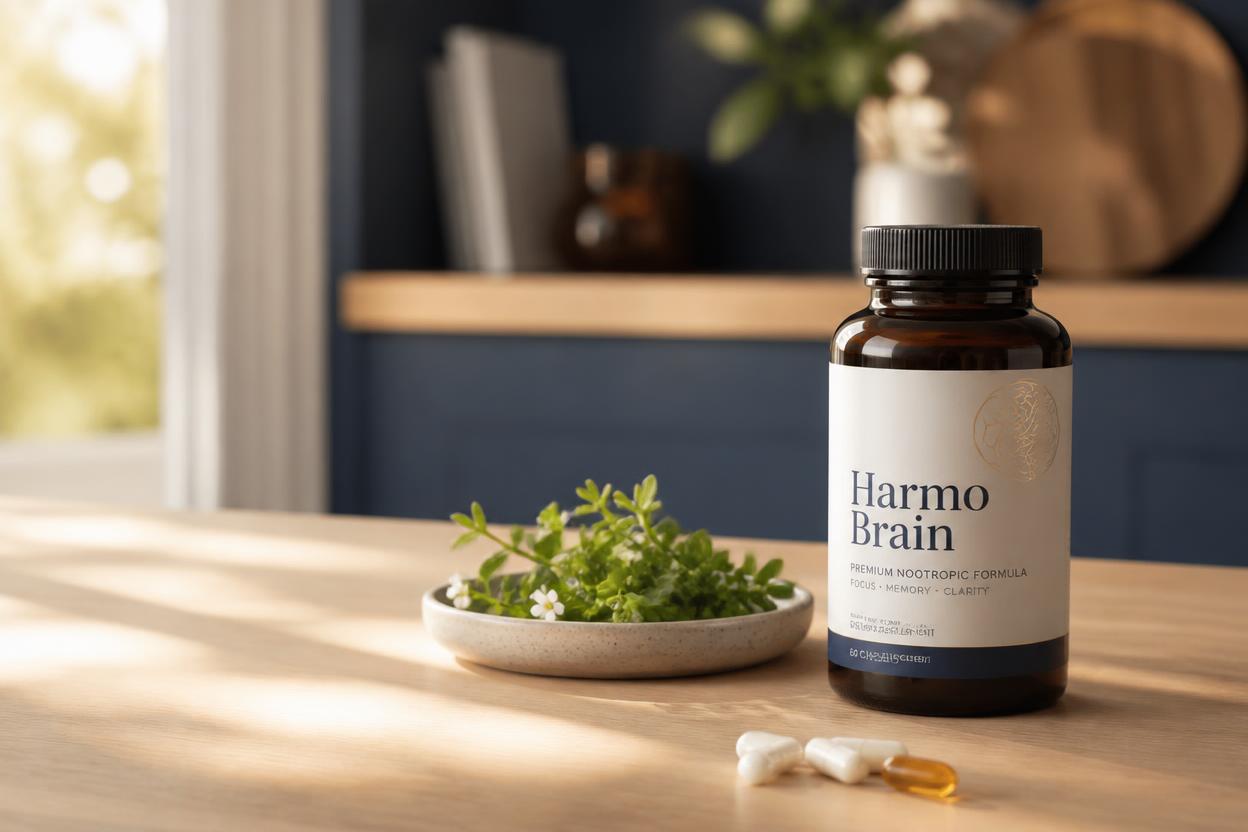
The three ingredients
Citicoline (CDP-Choline)
Citicoline is a choline source that crosses the blood-brain barrier efficiently. Once inside, it splits into choline and cytidine. Choline feeds acetylcholine synthesis, the neurotransmitter involved in attention and memory encoding. Cytidine supports phospholipid repair in cell membranes.
The 250 mg dose in Harmo Brain sits in the lower end of the studied range for attention and mental energy. For memory specifically, Nakazaki et al. (J Nutr, 2021, PMC8349115) used 500 mg Cognizin in adults with AAMI over 12 weeks and found improved episodic memory on computerized tests. The 250 mg here is half that dose, which may explain why some users report cognitive support rather than dramatic memory gains.
Bacopa monnieri (standardized)
Bacopa is an Ayurvedic herb with the strongest human data for memory among herbal nootropics. The active compounds are bacosides, which modulate choline acetyltransferase and support synaptic communication. Standardization matters: the extract in Harmo Brain is standardized for bacosides, which means the active content is consistent batch to batch. Plain powder is not.
The 300 mg dose matches Stough et al. (Psychopharmacology, 2001, PMID 11498727): 300 mg of CDR08 extract standardized for ≥55% bacosides, 12 weeks, n=46. The trial found improved delayed word recall and reduced state anxiety. A separate trial by Stough et al. in 2008 (Phytother Res, PMID 18683852) used a different dose and population, so the 2001 data is the most relevant match for this formula.
Phosphatidylserine (soy-derived)
Phosphatidylserine is a phospholipid that makes up part of cell membranes, including neurons. It supports membrane fluidity and signal transmission. The brain can synthesize some, but dietary intake becomes relevant with age.
The 100 mg dose matches Kato-Kataoka et al. (J Clin Biochem Nutr, 2010, PMID 20492494): 100 mg daily for six months in elderly adults with memory complaints. The effect was limited to a subgroup with low baseline performance. ConsumerLab notes that soy-derived PS provides a very modest benefit overall. It is not a dramatic memory enhancer, but it is a sensible addition to a formula aimed at aging brains.
How the three work together
Citicoline supplies the choline. Bacopa modulates how that choline is used in memory circuits. Phosphatidylserine maintains the membranes those signals travel across. The combination covers synthesis, modulation and structure. It is a coherent stack, not a random mix.
The weakness is dose. Citicoline at 250 mg is half the memory-study dose. Bacopa at 300 mg is on target. Phosphatidylserine at 100 mg is conservative. The formula is balanced but not aggressive. For users with mild concerns, that may be enough. For users with more pronounced issues, a higher-dose citicoline product might fit better.
What is not in the bottle
Absence matters as much as presence. Here is what Harmo Brain leaves out:
- Proprietary blend. Every dose is printed. You know exactly how much of each ingredient you are taking.
- Caffeine. No hidden stimulant. No afternoon crash, no tolerance, no sleep disruption.
- Artificial dyes or flavors. The capsules are plain. No blue #40, no titanium dioxide for color.
- Magnesium stearate. Some buyers avoid this flow agent. Harmo Brain uses it or not depending on the batch; check the label if this matters to you.
- Ginkgo biloba. A common memory supplement ingredient with bleeding-risk concerns. Not present here.
Who each ingredient helps most
Citicoline (250 mg): Best for people who need sustained attention and mental energy. Students, professionals, anyone who feels mentally foggy by mid-afternoon. The dose is conservative for memory but adequate for focus.
Bacopa (300 mg): Best for people who want memory support and are willing to wait 8 to 12 weeks. The data is strongest for delayed recall and word learning. Not a same-day fix.
Phosphatidylserine (100 mg): Best for adults over 50 with age-related memory concerns. The evidence is modest but consistent. It adds structural support rather than acute enhancement.
Safety notes
Citicoline warnings
Citicoline is a cholinergic. Some users report headache or difficulty sleeping, especially if taken late in the day. Take it in the morning. If headaches persist, stop and talk to your doctor. It can also interact with anticholinergic medications.
Phosphatidylserine warnings
Phosphatidylserine has a theoretical bleeding risk. It can interact with warfarin, aspirin and other anticoagulants. The 100 mg dose in Harmo Brain is conservative, but the interaction still matters. Show the label to your doctor if you take any blood thinner.
The bottom line
Harmo Brain is a coherent three-ingredient formula with transparent dosing. Citicoline at 250 mg supports attention. Bacopa at 300 mg matches a key memory trial. Phosphatidylserine at 100 mg adds modest structural support. The doses are honest, not inflated. The absence of caffeine, proprietary blends and artificial additives is a plus.
For the full safety profile, read our Harmo Brain side effects guide. For the scam investigation, see Is Harmo Brain a Scam?. For a comparison against competitors, go to Best Memory Supplements of 2026.
Frequently Asked Questions
Does Harmo Brain contain caffeine?
No. The label lists citicoline, bacopa monnieri and phosphatidylserine. No caffeine, no guarana, no theobromine. The energy effect, if you feel one, comes from cholinergic stimulation, not stimulants.
Is the bacopa in Harmo Brain standardized?
Yes. The label specifies a standardized extract. Standardization ensures consistent bacoside content batch to batch. Plain bacopa powder varies widely in potency and is not equivalent.
What is the difference between citicoline and choline bitartrate?
Citicoline crosses the blood-brain barrier more efficiently than choline bitartrate. More of the dose reaches the brain. That is why memory trials use citicoline or alpha-GPC, not bitartrate.
Why is the citicoline dose only 250 mg?
The 250 mg dose supports attention and mental energy. The memory trial by Nakazaki et al. (2021) used 500 mg. Harmo Brain splits the difference, likely to keep the capsule size manageable and the price competitive.
Does phosphatidylserine come from soy or animals?
Harmo Brain uses soy-derived phosphatidylserine. The bovine-derived form was more common decades ago but was restricted in some markets. Soy-derived PS has a longer modern safety record.
Are there any fillers in Harmo Brain?
The capsule contains the three active ingredients plus standard excipients for stability and flow. The label does not list artificial dyes or flavors. Check the Supplement Facts panel for the full list if you have specific allergies.
Can citicoline cause headaches or insomnia?
Yes. Citicoline is a cholinergic. Some users report headache or difficulty sleeping, especially if taken late in the day. Take it in the morning. If headaches persist, stop and talk to your doctor.
Does phosphatidylserine interact with blood thinners?
Yes. Phosphatidylserine has a theoretical bleeding risk. It can interact with warfarin, aspirin and other anticoagulants. The 100 mg dose in Harmo Brain is conservative, but the interaction still matters. Show the label to your doctor.
Sources and References
Need help choosing?
RecallPath does not sell supplements. We publish facts for readers over 40.
Email us